


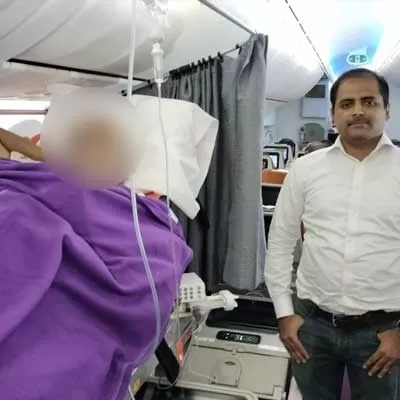
For patients living with respiratory conditions or recovering from serious illnesses, travelling internationally can require additional medical planning. Some patients may need supplementary oxygen during everyday activities or while sleeping. Naturally, this raises an important question: Can a patient travel with oxygen on a commercial flight?
In many situations, air travel with oxygen may be possible, but it requires careful assessment and advance coordination. Aircraft cabins have lower air pressure than conditions at sea level, which can affect oxygen levels in the body. A patient who manages comfortably on the ground may experience different oxygen requirements during a flight.
Understanding airline policies, medical clearance and approved oxygen equipment is essential before booking an international journey.
1. Can Patients Use Oxygen During a Commercial Flight?
Yes, some patients can travel on commercial flights with supplementary oxygen, subject to medical assessment and airline approval.
However, airlines do not necessarily permit passengers to bring their own oxygen cylinders or use any oxygen equipment they choose.
Depending on the airline, permitted arrangements may include:
An approved portable oxygen concentrator (POC).
Airline-provided oxygen, where available.
Other equipment specifically authorised by the airline.
The passenger must confirm the permitted equipment and arrangements directly with the airline before travelling.
2. Why Might a Patient Need Oxygen During a Flight?
Aircraft cabins are pressurised, but cabin air has a lower oxygen pressure than air at sea level. This can affect passengers who already have difficulty maintaining adequate oxygen levels.
Patients who may need an assessment for in-flight oxygen include those with:
Chronic respiratory conditions.
Certain lung diseases.
Some heart conditions.
Reduced oxygen levels.
Recent serious respiratory illness.
Other medical conditions affecting oxygen levels.
Not everyone with a respiratory condition needs oxygen during a flight. The decision should be based on an individual clinical assessment.
3. What Is a Portable Oxygen Concentrator?
A portable oxygen concentrator is a medical device that takes in surrounding air, separates oxygen from other gases and delivers concentrated oxygen to the patient.
Some airlines permit specific approved portable oxygen concentrator models onboard.
Before travelling, passengers should check:
Whether the airline accepts the device model.
Whether the device meets the airline’s requirements.
Whether sufficient battery power is available.
Whether spare batteries are permitted.
Whether the device can be used throughout the journey.
Whether the patient can operate it or needs assistance.
Approval for one airline does not automatically mean another airline will accept the same equipment.
4. What Medical Documents Are Required?
Patients who require oxygen during a flight may need supporting medical documentation.
Depending on the airline and the patient’s condition, documents may include:
| Document | Purpose |
|---|---|
| Medical fitness-to-fly assessment | Evaluates whether the patient is suitable for air travel |
| Doctor’s oxygen prescription | Explains the prescribed oxygen requirement |
| Medical summary | Provides information about the patient’s condition |
| Airline medical form | Supplies details required for airline assessment |
| Equipment details | Identifies the oxygen device and its specifications |
| Medication list | Provides details of current prescribed medicines |
Some airlines have specific medical clearance forms, often called MEDIF forms. Requirements and submission deadlines vary, so passengers should contact their airline well before departure.
5. How Much Oxygen Does a Patient Need During a Flight?
There is no single oxygen requirement for every patient.
The amount of oxygen needed depends on the patient’s medical condition, baseline oxygen levels, response to treatment and the effects of reduced cabin pressure.
A treating clinician may recommend additional assessment, such as a hypoxic challenge test, when clinically appropriate.
The clinician can use the results and the patient’s medical history to advise whether in-flight oxygen is required and what arrangements should be considered.
Passengers should never independently change their prescribed oxygen flow rate or assume that their usual home oxygen settings will be suitable during a flight.
6. What Should Patients Check Before Booking Their Flight?
Oxygen arrangements should be confirmed before purchasing tickets whenever possible.
Important questions include:
Does the airline permit the proposed oxygen device?
Is advance medical approval required?
What medical forms must be submitted?
Are there restrictions on battery capacity?
How many spare batteries can be carried?
Are there any requirements for connecting flights?
Can the equipment be used throughout boarding and the journey?
Does the patient need additional assistance at the airport?
If the journey involves multiple airlines, confirm the requirements with every operating carrier.
7. Can a Medical Escort Accompany a Patient Who Needs Oxygen?
A medical escort may accompany a patient who requires supplementary oxygen, provided the patient’s condition and travel requirements are suitable for the proposed arrangement.
Before confirming the journey, the patient’s treating clinician should assess fitness to fly and the level of support required.
A medical escort arrangement may involve:
Reviewing relevant medical information.
Coordinating travel requirements.
Confirming airline medical procedures.
Checking approved oxygen equipment arrangements.
Supporting the patient during the agreed journey.
Communicating with relevant personnel when assistance is needed.
The escort’s responsibilities depend on their professional qualifications and the service agreed in advance.
Important: A medical escort on a commercial flight is not equivalent to an air ambulance. Patients requiring continuous advanced respiratory support, intensive monitoring or hospital-level intervention may need specialised medical transport instead.
8. When Is an Air Ambulance More Appropriate?
Commercial air travel may not be suitable for every patient who needs oxygen.
An air ambulance or another specialised medical transport arrangement may need to be considered when a patient requires a higher level of medical support than can safely be provided during an ordinary commercial flight.
The decision depends on factors such as:
The patient’s medical stability.
Oxygen and respiratory support requirements.
Need for continuous monitoring.
Risk of deterioration during travel.
Need for specialised medical equipment.
Distance and complexity of the journey.
The treating medical team should help determine the appropriate transport option.
How to Prepare for an International Flight With Oxygen
If a patient has been assessed as suitable for commercial air travel, preparation can help avoid unnecessary complications.
Speak to the treating doctor: Obtain an individual assessment of fitness to fly and oxygen requirements.
Contact the airline: Request its medical clearance procedure and oxygen equipment policy.
Arrange approved equipment: Confirm that the device meets the airline’s requirements.
Prepare batteries: Check permitted battery capacity and calculate the power required for the entire journey, including delays.
Complete medical forms: Submit all requested documents within the airline’s deadline.
Plan connecting flights: Confirm that oxygen arrangements remain available throughout the route.
Arrange airport assistance: Discuss mobility and boarding support if required.
Keep documents accessible: Carry prescriptions, medical reports and airline approvals in hand luggage.
Frequently Asked Questions
1. Can I bring my own oxygen cylinder on an international flight?
Airline rules vary, and ordinary oxygen cylinders are not automatically permitted. Contact the airline to confirm which oxygen arrangements and equipment it accepts.
2. Are portable oxygen concentrators allowed on planes?
Some airlines permit approved portable oxygen concentrators. Passengers must check the accepted device models and complete any required approval process.
3. Do I need a doctor’s letter to fly with oxygen?
A doctor’s letter or prescription may be required, depending on the airline and the patient’s circumstances. Some airlines also require a medical clearance form.
4. Can a patient use oxygen throughout a long-haul flight?
This may be possible when the airline approves the equipment and the patient’s oxygen requirements have been assessed. Battery capacity and arrangements for the entire journey must be considered.
5. Can I use my home oxygen concentrator on a plane?
Not necessarily. A home oxygen concentrator may not meet airline requirements. Passengers should confirm which devices are approved for onboard use.
6. Can a patient with COPD travel internationally by plane?
Some patients with COPD can fly, while others may need additional assessment or oxygen arrangements. The treating clinician should assess the individual’s fitness to fly.
7. Can a medical escort help a patient who needs oxygen?
A suitably qualified medical escort may accompany an appropriate patient, depending on the agreed service and airline approval. The patient’s medical needs must be assessed before arranging travel.
8. What if the patient’s oxygen requirements increase during the flight?
The escort and passenger should follow the agreed medical plan and communicate with cabin crew when assistance is needed. Commercial aircraft have limitations, so patients with a significant risk of deterioration require careful assessment before departure.
Arrange International Medical Escort Assistance With MedEscort International
Travelling with oxygen requires careful coordination between the patient, treating doctor and airline. Medical clearance, approved equipment and suitable travel arrangements should all be confirmed before departure.
If you are arranging international travel for someone who requires medical assistance, MedEscort International can be contacted to discuss international medical escort arrangements and the support required for the journey.
Every enquiry should be reviewed according to the patient’s condition, oxygen requirements, airline policies and appropriate transport options.
Website:MedEscort International
Phone: +91 9774900430
Email:alan@medescortinternational.com
Planning an international journey for a patient who needs oxygen? Contact MedEscort International to discuss the travel arrangements.