


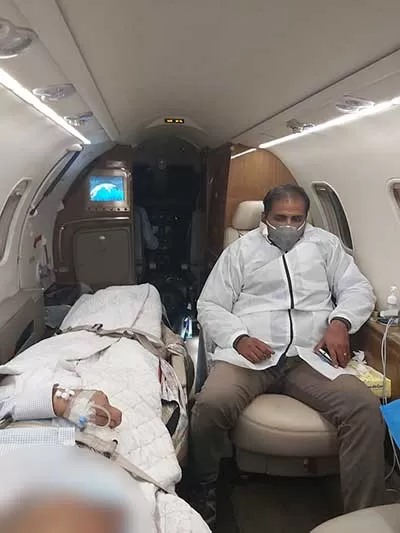
Confronting an acute complete high-cervical spinal cord injury (C1–C7), traumatic quadriplegia (tetraplegia), acute spinal shock with loss of descending sympathetic tone, or flaccid paralysis following a severe road traffic collision, diving mishap, or structural collapse overseas represents an exceptionally fragile, life-altering aeromedical situation. Every year, international adventure athletes, civil infrastructure contractors, foreign diplomats, expatriate corporate directors, and Non-Resident Indians (NRIs) sustain catastrophic spinal column disruptions while traveling across the Indian subcontinent. India’s quaternary neurosurgical and spinal trauma centers across Delhi NCR, Mumbai, Bengaluru, Chennai, and Hyderabad provide immediate, life-preserving neuro-intensive care: urgent posterior pedicle instrumentation, anterior cervical discectomy and fusion (ACDF), closed traction stabilization, and invasive hemodynamic resuscitation. Once acute transection shock stabilizes, transient flaccidity transitions toward reflexive stability, surgical alignment is verified on post-operative imaging, and patients reach transportable equilibrium, arranging an international patient transfer from India back to domestic level-1 spinal cord rehabilitation institutes, specialized neuro-trauma centers, or national spinal injury centers in North America, Europe, the United Kingdom, or Australasia becomes the decisive clinical objective. Because private air ambulance charters across intercontinental corridors demand six-figure outlays that can rapidly exhaust insurance lifetime maximums, scheduled commercial airline stretcher services provide a biomechanically secure, hemodynamically supported, and cost-effective corridor for moving patients from India under dedicated neurotrauma physician and critical care nurse supervision.
At MedEscort International, our critical care aeromedical flight doctors and neurotrauma-certified flight nurses coordinate every clinical, neurovascular, and mechanical facet of patient transfer from India for acute spinal shock and traumatic quadriplegia travelers. We oversee every logistical stage of moving patients from India, ensuring continuous spinal cord perfusion pressure maintenance, autonomic dysreflexia defense, neurogenic bladder and bowel management, decubitus ulcer prevention, and seamless bedside-to-bedside care. Learn more about our background and global standards on our About Us Page.
Understanding High-Cervical Neuro-Physiological Dynamics During Patient Transfer from India
Transporting a patient with acute quadriplegia or resolving spinal shock aboard a commercial passenger airliner requires rigorous management of high-altitude physics and spinal neurovascular dynamics. Commercial passenger aircraft cruise at pressurized cabin altitudes equivalent to 6,000 to 8,000 feet above sea level. This produces a drop in barometric pressure that results in lower alveolar oxygen tension ($PaO_2$). In the injured spinal cord, primary mechanical contusion is compounded by secondary ischemia; maintaining the spinal cord perfusion pressure ($SCPP = MAP – ISCP$) is vital. Flight clinicians must maintain strict Mean Arterial Pressure ($MAP$) targets—typically titrated to $\ge 85\text{–}90\text{ mmHg}$ using continuous arterial line telemetry or automated non-invasive blood pressure protocols—to protect the ischemic penumbra surrounding the cord lesion. In cervical and high-thoracic (above T6) injuries, disruption of the sympathetic chain precipitates neurogenic shock, characterized by profound vasodilation, peripheral pooling, systemic hypotension, and paradoxical bradycardia. Exposure to cruising altitudes also magnifies the risk of poikilothermia; high-cervical quadriplegic patients lose autonomic vasoconstriction and thermoregulatory shivering below the lesion level, making them vulnerable to cabin-induced hypothermia, which spikes myocardial oxygen consumption and worsens cord ischemia. Furthermore, under Boyle’s Law, gas trapped within body cavities expands by 25% to 30% at cruising altitude. Gastric distension from paralytic ileus or aerophagia can elevate the diaphragm against a compromised phrenic nerve (C3–C5), precipitating sudden respiratory failure unless a nasogastric/orogastric decompression tube is vented. Catheter retention balloons must be filled with sterile liquid rather than air, and autonomic dysreflexia—hypertensive crises triggered by full bladders or tight garments—must be guarded against continuously. When moving patients from India, our aeromedical team enforces strict 2-hour inline log-roll repositioning, active pulmonary toilet, and mechanical deep vein thrombosis (DVT) prophylaxis compliant with IATA and DGCA India regulations.
Customized travel options for spinal shock and quadriplegia patient transfer from India include:
Commercial Airline Stretcher Service (Installed across 6 to 9 economy rows on wide-body aircraft to accommodate recumbent stretchers, rigid cervical orthoses, and full clinical clearance)
Continuous DGCA, FAA & EASA-approved Portable Oxygen Concentrators (POC) with backup lithium battery arrays to sustain systemic and cord oxygenation
Precision battery-operated syringe-driver pumps for continuous intravenous vasopressor support (e.g., norepinephrine, dopamine) to defend $MAP$ targets
Multi-chamber pressure-relief mattress overlays and silicone gel pads to prevent skin shear and pressure necrosis over the occiput, sacrum, and heels
Full-body vacuum immobilization mattresses and rigid cervical collars (e.g., Aspen, Miami J) to maintain rigid axial alignment during turbulence, takeoff, and landing
Direct bedside-to-bedside coordination uniting sending neurotrauma surgical ICUs in India with receiving spinal rehabilitation centers abroad
Discover our complete portfolio of international patient transport and aeromedical solutions on our Our Services Page.
Moving Patients from India Across Major Global Spinal Injury Corridors
We coordinate specialized quadriplegia and acute spinal injury flight repatriations from premier Indian spinal trauma units to leading international neuro-rehabilitation hospitals, including:
Delhi (DEL) / Mumbai (BOM) to Lyndhurst Centre (Toronto Rehab – UHN) & GF Strong Rehabilitation Centre Vancouver [Canada]
Delhi (DEL) / Bengaluru (BLR) to Craig Hospital Englewood (Denver), Shepherd Center Atlanta & Shirley Ryan AbilityLab Chicago [USA]
Mumbai (BOM) / Delhi (DEL) to National Spinal Injuries Centre (Stoke Mandeville Hospital) & Royal National Orthopaedic Hospital Stanmore [UK]
Chennai (MAA) / Hyderabad (HYD) / Kochi (COK) to Amana Healthcare Abu Dhabi & Qatar Rehabilitation Institute (HMC) Doha [Middle East]
Delhi (DEL) / Mumbai (BOM) to Austin Health (Victorian Spinal Cord Service) Melbourne & Royal North Shore Hospital Spinal Injuries Unit Sydney [Australia]
Our case management team coordinates directly with international wide-body operators (such as Air India, Emirates, Qatar Airways, British Airways, and Singapore Airlines) to arrange priority medical clearance (MEDIF), wide-body stretcher installation, and tarmac high-loader ambulift boarding.
Clinical Profiles Benefiting from Moving Patients from India
Complete & Incomplete Cervical Cord Trauma (AIS Grade A–D)
Patients with acute traumatic cervical spinal injuries (C3–C7) status-post rigid decompression and stabilization instrumentation who require intensive blood pressure titration, pulmonary hygiene, and immobilization.
Acute Spinal Shock with Resolving Hemodynamic Instability
Individuals transitioning out of acute neurogenic shock who are weaned to low-dose oral or syringe-driven vasopressors, requiring constant $MAP$ monitoring and cardiac rate oversight.
Diaphragm-Paced or Tracheostomized High-Cervical Injuries
Quadriplegic patients breathing spontaneously or via specialized negative/positive pressure support who require specialized airway humidification, subglottic suctioning, and tracheostomy care.
Complex Polytrauma with Concomitant Spinal Cord Injury
Trauma victims recovering from concurrent long-bone fractures, thoracic blunt trauma with resolved contusions/hemothorax, and pelvic disruptions requiring continuous log-roll positioning and multimodal pain control.
Advanced In-Flight Care & Specialized Neuro-Spinal Equipment
When carrying out a patient transfer from India for quadriplegic and spinal shock travelers, our flight clinicians deploy specialized monitoring, neurovascular, and life-support kits compliant with civil aviation standards:
Continuous multi-parameter hemodynamic telemetry: continuous 12-lead ECG rhythm strips, automated non-invasive blood pressure, high-resolution pulse oximetry ($SpO_2$), and digital core body temperature monitoring
Neuro-critical pharmacopoeia: pre-filled vasopressor infusions (norepinephrine, phenylephrine via certified syringe pumps) for neurogenic shock, rapid-acting antihypertensives (hydralazine, nitrates) for autonomic dysreflexia, and scheduled neuropathic analgesia
Aviation-cleared Portable Oxygen Concentrators (POC) with 150% battery backup capacity for uninterrupted tissue perfusion
Spinal stabilization systems: rigid cervical orthoses, thoracic-lumbar-sacral orthoses (TLSO), and full-body multi-chamber evacuation vacuum mattresses
Pulmonary toilet and suction gear: battery-powered suction units, sterile suction catheters, manually assisted cough (quad-cough) equipment, and heat-moisture exchangers (HME)
All medical personnel assigned to quadriplegia escort missions are critical care certified physicians, neuro-anesthesiologists, or neurotrauma flight nurses with extensive clinical experience in spinal cord injury ICUs.
Complete Bedside-to-Bedside Logistics
Our bedside-to-bedside coordination ensures seamless clinical continuity throughout every stage of moving patients from India to receiving medical centers abroad:
Direct bedside assessment, review of post-stabilization CT/MRI imaging, ASIA impairment scoring, surgical construct integrity audit, and detailed handover from treating spine surgeons in India
Mobile Intensive Care Unit (MICU) ground ambulance transport equipped with air-suspension stretcher systems directly to the departure aircraft
Priority tarmac ambulift boarding directly through aircraft service doors, maintaining rigid axial inline head-neck-torso alignment without spinal flexion or rotation
In-flight clinical supervision: continuous $MAP$ management, scheduled 2-hour inline log-roll repositioning, urinary drainage monitoring, and aggressive DVT defense
Expedited port health, customs, and immigration clearances upon international arrival
Receiving ground ambulance transfer directly to the destination hospital’s spinal injury unit or specialized neuro-rehabilitation center
Learn more about our comprehensive door-to-door escort process on our Patient Transfer Services.
Benefits of Choosing a Commercial Medical Escort
Cost-Effective Alternative to Air Ambulances
Commercial airline stretcher transfers provide a fraction of the cost of dedicated private jet air ambulances, preserving vital family insurance limits and personal finances for lifelong neuro-rehabilitation and home modifications.
Optimal Vibration Damping on Wide-Body Aircraft
Commercial wide-body aircraft (such as Boeing 777/787 or Airbus A350) provide superior mass, cabin stabilization, and reduced high-frequency turbulence compared to light private jets, shielding fresh spinal fusions and unstable constructs from painful mechanical shock.
Dedicated One-on-One Specialized Clinical Care
The patient receives continuous, focused attention from an experienced neurotrauma flight team dedicated to spinal cord perfusion, neurogenic protection, and patient comfort.
Complete Airline & Civil Aviation Logistics Handling
We manage all airline medical clearance forms (MEDIF), stretcher installation engineering reviews, lithium battery certifications for medical pumps, and tarmac ambulift coordination.
Why Choose MedEscort International for Moving Patients from India?
MedEscort International is a globally trusted provider of medical repatriation and international flight escort services.
What sets our services apart:
Comprehensive understanding of altitude spinal cord perfusion dynamics, autonomic dysreflexia triggers, and mechanical trauma stability
Certified neurotrauma flight doctors and critical care nurses skilled in log-roll maneuvers and spinal alignment
Zero-gap bedside-to-bedside transfers that eliminate physical strain and accidental construct displacement
24/7 dedicated medical flight desks and active case coordination
Transparent pricing with no hidden costs
Our medical team works hand-in-hand with treating spine surgeons in India, receiving neuro-rehabilitation directors abroad, and airline medical desks to ensure a smooth transition. Learn more about our experience on our About Us Page.
Conclusion
Executing a traumatic quadriplegia or acute spinal shock patient transfer from India demands detailed biomechanical preparation, hemodynamic precision, autonomic vigilance, and expert aeromedical coordination. Whether moving patients from India to Denver, Toronto, London, Sydney, Chicago, or Vancouver, commercial medical escort services deliver a reliable, gentle, and financially practical bridge to bring injured patients safely to specialized spinal rehabilitation facilities.
To discuss an upcoming spinal injury or quadriplegia case or request a free aeromedical assessment, visit our Contact Us Page or explore our Patient Transfer Services.
Contact Us
If you or a loved one require Medical Escort Services or air ambulance transportation for safe, efficient, and compassionate care.
Call Us: +919774900430
Email: alan@medescortinternational.com
Address: HN-8/258 F/F Village Mehram Nagar Vasant Kunj Near Domestic Airport, New Delhi 110037